The Collection
Acknowledgement
This exhibition emerges from sustained engagement with Taíno history, material culture, and the long aftermath of colonial erasure. I am a white artist, and although I admire much of their story, I claim no relationship beyond admiration. The ceramics in this collection are my response to what I found in scholarship. It is an attempt to think through clay about histories that written records have largely failed to preserve. I have tried throughout to be a student of this material, not an interpreter of it, and certainly not a surrogate for the artists and communities whose stories these are.
The goal of this exhibition is redirection towards awareness of the Taíno people, towards the ongoing work of Indigenous Caribbean scholars and activists, and towards the living artists who carry this tradition with an authority I do not have and do not claim.
Three Haitian artists in particular have shaped how I understand this history and what art in its service can look like. Their work deserves your attention.


This vase is inspired by a similar Taíno vase meant to represent human anatomy and the essential topic of fertility. It carried great weight in Taíno culture, and this reinterpretation is meant to convey that alongside the many horrors and realities we all to quickly shy away from in indigenous history.


This plate represents the inherently warped aspects of Caribbean society today, introduced by the horrors of Spanish practice while also conveying the natural and human beauty of the area.

This is a modern reimagining of the classic Taíno motif of a spiral, in three dimensions. It is on a raw clay background to represent the inherently natural aspects of indigenous artistry.


This bowl is a modern reimagining of a classic Taíno bowl, employing inlay technique to create a striking design.

These two cup figures are intended to illustrate the personal fragmentation that often comes with the abhorrent realities of imperialism, specifically in relation to the Taíno people.

This vase includes my interpretation of a traditional design, materialized through grounded and natural materials.
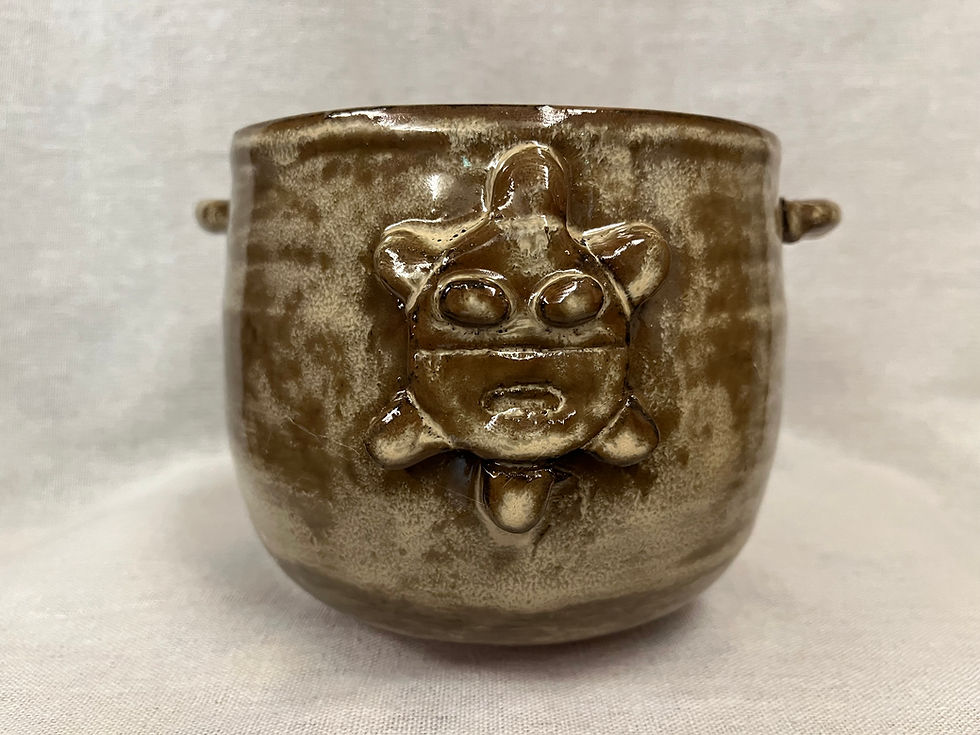
This bowl is the ceramic form of a traditional Taíno figure. The gritty, sandy, natural glaze is meant to connect to both physical and abstract qualities of their story.

This small bowl is intended to shine in its simplicity; the concept of sand and sea is intrinsically tied to many's costal identity.

This bowl is meant to symbolize the loss that comes with cultural suppression through the physical void of the dark glaze.

This mug is supposed to be a natural materialization of what makes us, everyone, human. That being our connection to others and natural conception of humanity, even in vague and unrelated things.

This figure is directly inspired by the stylization of a Taíno religious pendant used in prayer. The goal of this piece is to highlight the variation in roles ceramic artistry can hod.

This vase is inspired by the woven textiles and baskets of the people indigenous to the Caribbean. It is mixing an ancient concept with modern fluxy, heady glaze.

This bowl is the concept of environmental destruction, like that which can be seen on the border of Haiti and the Dominican Republic. This reality has profound impacts upon Haiti's people and further works to illustrate the inherently evil aspects of colonialism.


